Introduction
Digital twins are reshaping industrial operations. A digital twin is a virtual replica of a physical system that receives real-time data from its physical counterpart, enabling simulation, prediction, and control at unprecedented fidelity.
The Architecture of a Digital Twin
A digital twin consists of three layers:
- The physical layer — sensors, actuators, and the real-world system being modeled
- The digital layer — the software representation, simulation models, and analytics
- The integration layer — data pipelines that synchronize the physical and digital
Palantir Foundry and Digital Twins
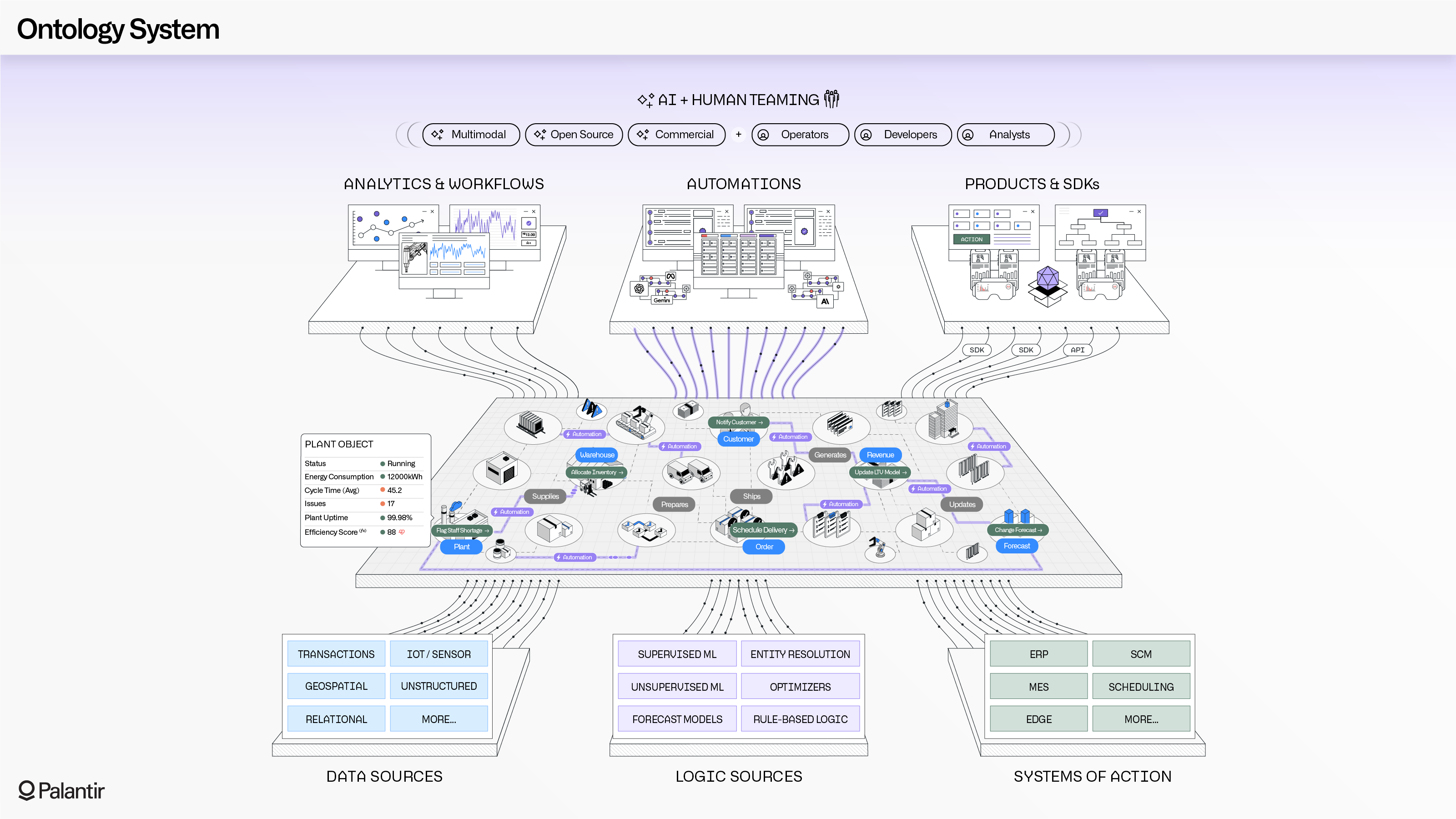
Palantir's Foundry platform has emerged as a leading infrastructure for building digital twin applications at enterprise scale. Its core abstraction is the Ontology: a semantic layer that maps real-world entities (sensors, machines, operators) to digital objects with typed properties and relationships.
- Ontology management — mapping real-world entities to digital objects
- Data integration — ingesting sensor data from diverse sources
- Operational workflows — enabling decisions to flow back to the physical system
Advanced Applications
Modern digital twin deployments go far beyond simple monitoring:
- Predictive maintenance — models trained on historical failure data predict when equipment needs service
- What-if simulation — operators can test scenarios without risk to the physical system
- Autonomous control — closed-loop systems that adjust operations based on twin predictions
The Future
As IoT sensor costs drop and compute becomes cheaper, digital twins will become the standard operating model for industrial infrastructure. The convergence of 5G, edge computing, and AI will make real-time synchronization between physical and digital systems the norm rather than the exception.